
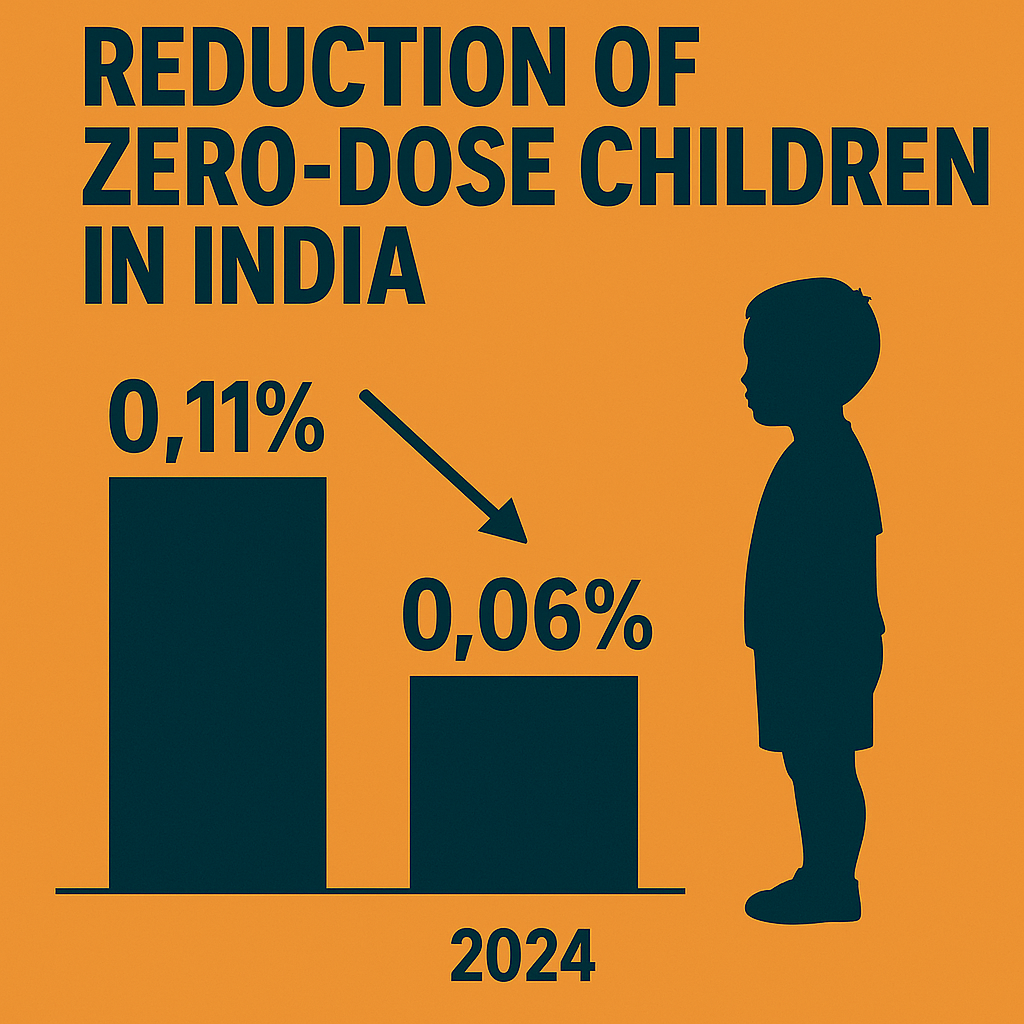
India achieved a landmark reduction in its zero-dose children—those who have not received even a single vaccine—declining from 0.11% in 2023 to 0.06% in 2024, as reported by the UN Inter-Agency Group for Child Mortality Estimation (UN IGME) 2024 report. This progress underscores India’s intensified focus on reaching every child through targeted immunization initiatives.
Zero-dose children reduction in India
Key Drivers of Progress
Zero Dose Implementation Plan 2024
A focused plan was rolled out across 143 high-burden districts in 11 states, deploying dedicated outreach teams and enhanced monitoring to identify and vaccinate unserved children.
Mission Indradhanush (MI) & Intensified Mission Indradhanush (IMI)
Launched in 2014 and intensified in 2017, these campaigns have completed 12 phases by 2023, vaccinating 5.46 crore children and 1.32 crore pregnant women, significantly boosting last-mile delivery.
Universal Immunisation Programme (UIP) Enhancements
Under UIP, India offers the maximum number of WHO-recommended vaccines, achieving a mean coverage of 83.4%, over 10 percentage points above the global average. Electronic tracking via the UWIN portal ensures real-time monitoring of each child’s vaccination status.
Community Engagement
ASHAs, ANMs, and local health workers conduct over 1.3 crore immunization sessions annually, employing Information, Education, and Communication (IEC) campaigns to address vaccine hesitancy and improve awareness.
Impact and Global Recognition
- India’s zero-dose rate of 0.06% places it among the top performers globally in child immunization.
- The country received the Measles and Rubella Champion Award from The Measles & Rubella Partnership in March 2024 for its exemplary efforts in vaccination coverage.
- Comparative gains:
- DTP-1 coverage at 93%, on par with high-income countries like Germany and Sweden, and substantially higher than Nigeria’s 70%.
- Dropout rate from DTP-1 to DTP-3 reduced from 7% in 2013 to 2% in 2023.
Challenges and the Road Ahead
Despite impressive gains, sustaining momentum requires:
- Expanding outreach to remote and marginalized communities.
- Maintaining high coverage for newer vaccines added under UIP.
- Strengthening data systems to promptly identify and follow up with zero-dose children.
- Collaborating with international partners to adopt best practices and secure resources.
India’s achievement in nearly halving its zero-dose rate within a year exemplifies the effectiveness of concerted public health strategies, robust community engagement, and digital innovation. As the nation strives toward universal immunization, these efforts will be crucial in safeguarding child health and achieving Sustainable Development Goal targets.