
In a decisive response to evolving regional security threats, India has fast-tracked the launch of 52 dedicated surveillance satellites under the ambitious Space-Based Surveillance-III (SBS-III) programme, marking a transformative leap in the nation’s defense capabilities. This ₹26,968 crore ($3.2 billion) initiative represents the largest military space program in India’s history, designed to provide round-the-clock monitoring of borders and coastlines with unprecedented precision and coverage.
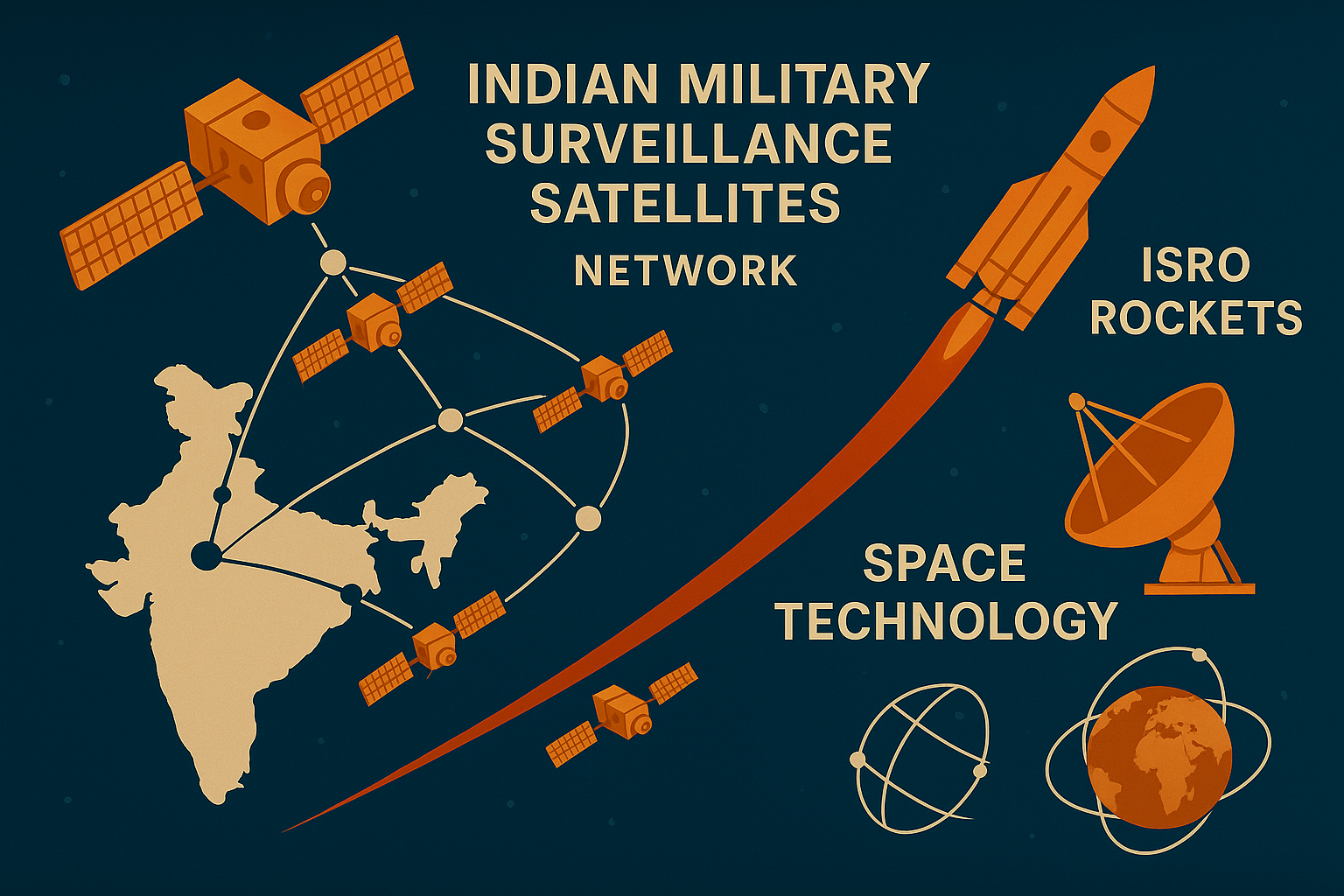
India’s surveillance satellite constellation monitoring borders
Operation Sindoor: The Catalyst for Acceleration
The urgency behind this satellite constellation stems directly from lessons learned during Operation Sindoor in May 2025, when India conducted precision strikes against terrorist infrastructure across the border. ISRO Chairman Dr. V. Narayanan revealed that at least ten satellites worked round-the-clock to provide real-time intelligence, secure communications, and precision navigation during the operation. This experience highlighted the critical importance of indigenous satellite capabilities for national security operations.
The success of Operation Sindoor was made possible by ISRO’s seamless integration with military operational plans, utilizing high-resolution Earth observation systems like the Cartosat and RISAT series that delivered continuous surveillance across terrain, borders, and hostile airspace—regardless of weather or time of day. However, the operation also exposed gaps in India’s surveillance coverage, prompting the government to slash the SBS-III timeline from four years to just 12-18 months.
Revolutionary SBS-III Programme Architecture
The SBS-III programme represents a paradigm shift in India’s military space capabilities, featuring several groundbreaking elements:
Public-Private Partnership Model
For the first time in India’s strategic space program, private industry will play a major role in developing satellites for national security purposes. The programme involves 21 satellites to be developed by ISRO and 31 by three private companies, with contracts expected to be signed imminently. Three private firms from South Indian states have been shortlisted, with one producing 15 satellites and the other two producing eight satellites each.
Advanced AI-Powered Satellite Network
The new constellation will utilize artificial intelligence to enable unprecedented satellite interaction and intelligence gathering. Satellites positioned in both Low Earth Orbit (LEO) at 400-600km and Geostationary Orbit (GEO) at 36,000km will form an integrated network, allowing for dynamic cooperation where GEO satellites can detect activities and direct LEO satellites to provide detailed surveillance.
“We will have communication between satellites, so that if one in GEO detects activity, it can task another satellite in a lower orbit to take a closer look and gather more information,” explained a senior ISRO official.
Enhanced Coverage and Capabilities
The SBS-III aims to cover much larger areas of China and Pakistan, along with the Indian Ocean Region, with shorter revisit times and better resolution. The satellites will provide round-the-clock monitoring, unaffected by weather, time of day, or atmospheric conditions, enabling the Indian Army, Navy, and Air Force to monitor adversary movements deep inside hostile territory—including airfields, bases, and staging areas.
Defence Space Agency: Command and Control
The Defence Space Agency (DSA), formed in 2019 under the Integrated Defence Staff of the Ministry of Defence, is leading the SBS-III project. The DSA replaced the Integrated Space Cell and now oversees India’s military space operations, coordinating with ISRO, DRDO, and the armed forces to develop space warfare strategies and safeguard national space assets.
The DSA is expected to evolve into a full-fledged Space Command, with a roadmap to deploy over 100 military satellites within the next 7 to 8 years. This organizational evolution reflects India’s recognition that space is no longer a domain used for peaceful purposes, but has drifted into the territory of strategic competitiveness.
Strategic Response to Regional Threats
The acceleration of the SBS-III programme is driven by China’s rapidly expanding military space capabilities, with its satellite fleet surging from 36 in 2020 to over 1,000 by 2024, including 360 satellites focused solely on intelligence, surveillance and reconnaissance (ISR). Additionally, China’s sharing of satellite intelligence on India with Pakistan, as confirmed by Pakistan’s Defence Minister, underscores the urgency of developing indigenous capabilities.
Chief of Integrated Defence Staff Air Marshal Ashutosh Dixit emphasized that India must “detect, identify and track” potential threats not when they approach the borders but when they are still in their staging areas, airfields and bases, “deep within an adversary’s territory”.
Technology Transfer and Rapid Deployment
A crucial aspect of the SBS-III programme is the planned transfer of Small Satellite Launch Vehicle (SSLV) technology from ISRO to private players, which will enable rapid satellite launches during emergencies. The Indian National Space Promotion and Authorisation Centre (IN-SPACe) has invited bids for the complete transfer of SSLV technology to private Indian industries, marking a significant milestone for the Indian space sector.
Unlike the Polar Satellite Launch Vehicle (PSLV), where a manufacturing contract was awarded to a consortium, the SSLV launch vehicle technology is being offered in its entirety to private industry. This approach is expected to grow the small satellite launch segment significantly, paving the way for India to become the global hub for such launches.
Timeline and Implementation
The first satellite under the SBS-III programme is expected to be launched by April 2026, with the full constellation targeted for completion by the end of 2029. However, given the accelerated timeline following Operation Sindoor, efforts are underway to compress these schedules.
ISRO Chairman V. Narayanan highlighted the necessity of monitoring India’s 7,000 km coastline and northern borders, stating that “at least 10 satellites are continuously working round-the-clock for strategic purposes to ensure the safety and security of the citizens of the country”.
Financial Investment and Economic Impact
The SBS-III programme is part of India’s broader commitment to defense modernization, with the 2025-26 defense budget allocating ₹6.81 lakh crore, representing a 9.5% increase from the previous year. The programme’s ₹26,968 crore investment reflects India’s determination to achieve strategic autonomy in space-based surveillance capabilities.
This investment aligns with India’s ambition to grow its space economy from $8.4 billion to $44 billion by 2033, positioning the country as a major player in the global space industry.
Future Implications
The SBS-III programme represents more than just a technological upgrade—it signifies India’s transition from a reactive to a proactive defense posture in space. The constellation will provide actionable intelligence to the Indian Army, Navy, Air Force, and agencies like the Research and Analysis Wing (RAW) and National Technical Research Organisation (NTRO).
Beyond defense applications, these satellites will play a crucial role in disaster management, with advanced sensors capable of detecting natural disasters such as cyclones, floods, and forest fires. The high-resolution imagery will also support agricultural planning, urban development, and environmental monitoring.
As India moves toward becoming a Viksit Bharat (developed India) by 2047, the SBS-III programme stands as a testament to the nation’s technological capabilities and strategic foresight. By combining indigenous innovation with private sector efficiency, India is positioning itself as a formidable space power capable of safeguarding its interests in an increasingly complex geopolitical environment.
The success of this programme will not only enhance India’s national security but also demonstrate the country’s ability to leverage space technology for comprehensive national development, marking a new chapter in India’s journey toward strategic autonomy and technological self-reliance.